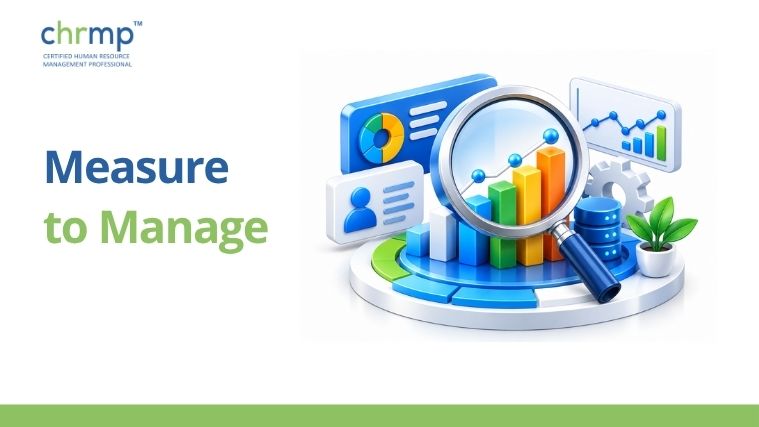
In our everyday lives, numbers quietly guide many of the decisions we make.
We measure the amount of protein we consume, monitor our weight and BMI, count repetitions at the gym, track the minutes spent on a treadmill, and pay attention to the proportion of ingredients that go into our food. These measurements may appear routine, but they help us understand whether we are moving towards a desired state of health and performance.
If we rely on measurement to understand and improve ourselves, why should organisations be any different?
In an increasingly volatile and dynamic business environment, organisations are progressively moving towards data-driven decision-making. However, HR metrics are not merely numbers on a dashboard. When interpreted in the right context, they become a catalyst for leadership to understand organisational health, identify gaps, make informed decisions, and ultimately support business growth.
Organisations have always dealt with questions that are fundamentally qualitative:
Are our employees engaged? Are we attracting the right talent? Are we creating an inclusive workplace? Are our employees satisfied with the Employee Value Proposition (EVP)?
The challenge is that observations alone do not always provide enough evidence to act upon. This is where HR Analytics becomes relevant.
By translating appropriate aspects of the employee experience into measurable indicators, organisations can identify patterns, establish benchmarks, monitor progress and, most importantly, ask better questions.
Metrics and KPIs therefore do not simply tell us what is happening. When analysed thoughtfully, they help us explore why it is happening and what can be done differently.
In that sense, HR Analytics can be viewed as a performance management mechanism—not just for employees, but for the organisation itself.
Talent Acquisition
Metrics such as Time to Fill, Time to Hire, requisition ageing, offer-to-join ratio, and funnel conversion rates can provide insights into the efficiency of the hiring process.
For instance, if a critical position remains open for an extended period, the number itself is only the starting point. The real analytical question is:
What is driving the ageing of the requisition? Is it a shortage of relevant talent in the market?
Is the compensation benchmark not competitive?
Is the hiring process too lengthy? Are hiring managers taking longer to close positions?
Or are candidates dropping out at a particular stage?
The metric identifies the signal. Analytics helps us investigate the story behind the signal.
Diversity: Measuring inclusion beyond intent
The same principle applies to Diversity, Equity and Inclusion.
An organisation may have a strong intent to create a diverse workforce, but intent needs to translate into observable outcomes.
Metrics across gender representation, hiring ratios, promotion rates, retention, leadership diversity and internal mobility can help organisations understand whether their inclusion strategies are translating into meaningful change.
For example, if an organisation has strong diversity at entry-level positions but significantly lower representation at leadership levels, the metric raises an important organisational question:
Where in the employee lifecycle is the gap emerging?
This is where HR Analytics moves beyond reporting and begins to contribute to organisational diagnosis.
When a metric influences a policy decision.
One metric that particularly illustrates this connection is Offer Decline. An offer declined is not simply a recruitment outcome. The reasons behind offer declines can provide valuable market intelligence.
Are candidates receiving better compensation elsewhere?
Are competitors offering greater flexibility? Is the organisation’s career proposition compelling enough? Are candidates looking for benefits that our current EVP does not adequately address?
When analysed systematically, offer-decline data can help an organisation understand how its proposition compares with the external talent market and where it may need to strengthen its Employee Value Proposition.
For example, organisations have increasingly differentiated themselves through benefits that respond to the evolving needs of employees and their families. Godrej Consumer Products’ initiatives around parental medical benefits are an example of how employee needs can influence the evolution of an organisation’s value proposition.
The point is not simply to introduce another benefit. The larger question is:
What does the data tell us about what employees value, and how can the organisation respond meaningfully? Think of an organisation like the human body
Perhaps the simplest analogy is our own health.
A healthy body is not assessed through a single number. We look at indicators such as BMI, blood pressure, cholesterol, blood sugar, fitness levels and other relevant measures.One metric rarely tells the complete story.
Similarly, an organisation’s health cannot be determined by a single KPI.
- Attrition may tell us something about retention.
- Engagement scores may tell us something about employee sentiment.
- Time to Fill may indicate aspects of talent acquisition efficiency.
- Internal mobility may indicate career movement.
- Diversity metrics may reveal representation gaps.
- Offer declines may provide insight into external market competitiveness.
Individually, these are measurements.
Collectively—and when interpreted in context—they can provide a much more meaningful picture of organisational health.
The objective is not to achieve a perfect number for every metric. The objective is to understand where the organisation currently stands, where the gaps exist, and which interventions can create meaningful improvement.
From Measurement to Organisational Growth
HR Analytics is not merely about reporting numbers; it is about turning data into insights, decisions, and meaningful action.
For organisations, the objective is to understand where they stand, identify the gaps, and determine what needs to change to improve both people and business outcomes.
As the saying goes, “What gets measured gets managed.”
But in HR Analytics, I believe the journey goes one step further:
What we measure helps us understand.
What we understand helps us decide.
What we decide helps us manage better.
HR Analytics is not about reducing people to numbers. It is about using numbers responsibly to understand people better and build healthier, more agile and high-performing organisations.